Futures Approaching as Polysilicon Prices Continue to Rise: What's Next for the Market? [SMM Analysis]

Published: Dec 19, 2024 14:30
[SMM Analysis: Polysilicon Prices Continue to Rise Ahead of Futures—What’s Next for the Market?] According to SMM data, polysilicon prices, which had been hovering at the bottom for a long time, have recently shown signs of recovery. Starting from December, polysilicon prices have risen for two consecutive weeks. At the end of November, transaction prices for polysilicon remained around 38 yuan/kg. In contrast, as of now, some delivery prices have approached 40 yuan/kg. During the order signing period, several mainstream producers have concentrated their quotations at 42 yuan/kg.

SMM, December 19:

According to SMM data, the long-stagnant polysilicon prices have recently seen a recovery. Starting from December, polysilicon prices have risen for two consecutive weeks. At the end of November, polysilicon transaction prices were maintained at around 38 yuan/kg. As of now, some delivery prices have approached 40 yuan/kg. During the order signing period, several mainstream producers have collectively quoted 42 yuan/kg.
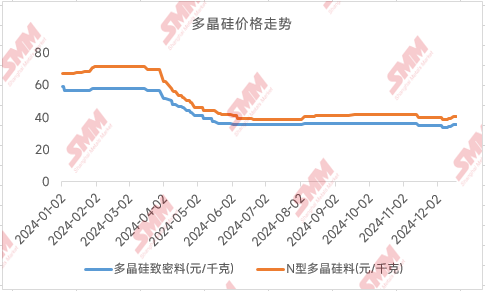
SMM understands that this price increase is mainly driven by mainstream enterprises actively standing firm on quotes. The convening of association meetings has led to effective progress in industry self-discipline, resulting in a certain recovery in market confidence. Polysilicon futures will officially launch on December 26, providing polysilicon producers with more options. Coupled with other factors such as price increases in downstream segments, polysilicon prices have risen.

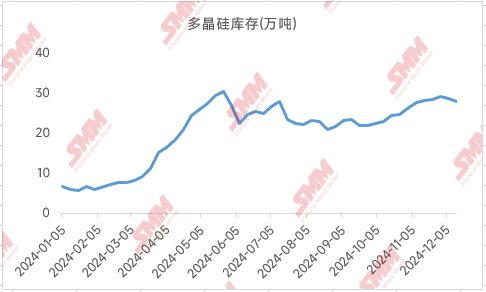
Currently, polysilicon seller inventories remain at the level of 278,000 mt. Although supply and demand have become tightly balanced in December due to production cuts, considering that inventories have not shown a true supply shortage, the situation remains stable.
Regarding future trends, SMM understands that polysilicon producers exhibit strong sentiment to stand firm on quotes in this round of pricing. Currently, traceable materials and even some high-quality polysilicon are quoted at 44-45 yuan/kg. Combined with the potential for production increases in the silicon wafer segment, the probability of further increases in polysilicon order signing prices is high, with the market showing a high acceptance of the 42 yuan/kg price. However, it is worth noting that the polysilicon price increase still lacks fundamental support from supply and demand. In January and the subsequent months, module demand is expected to remain weak, and prices are likely to lack support during the traditional off-season of January-February.

》View the SMM PV Industry Chain Database

Data Source Statement: Except for publicly available information, all other data are processed by SMM based on publicly available information, market communication, and relying on SMM‘s internal database model. They are for reference only and do not constitute decision-making recommendations.

For any inquiries or to learn more information, please contact: lemonzhao@smm.cn
For more information on how to access our research reports, please contact:service.en@smm.cn
Related News
[SMM PV News] Indonesia Proposes 180-Day Plan for 100 GW Solar Goal
4 hours ago
[SMM PV News] Indonesia Proposes 180-Day Plan for 100 GW Solar Goal
Read More
[SMM PV News] Indonesia Proposes 180-Day Plan for 100 GW Solar Goal
[SMM PV News] Indonesia Proposes 180-Day Plan for 100 GW Solar Goal
Research from Indonesia's Institute for Essential Services Reform (IESR) outlines a 180-day action plan to operationalize the country's 100 GW solar target. The initiative includes 80 GW of decentralized solar-plus-storage across 80,000 villages and 20 GW of centralized solar. IESR recommends designating it a national strategic program and adopting a differentiated approach rather than a uniform 1 MW/4 MWh system per village to avoid stranded assets. Implementing this requires a $78 billion phase-one investment, with subsequent costs estimated at $140-210 billion, plus training for 100,000 installers. A task force has already been established, alongside a $1.4 billion investment for a 50 GW domestic manufacturing facility to support the massive rollout.
4 hours ago
[SMM PV News] Kyocera and Cosmo Energy Sign Reciprocal Solar-Wind PPAs
4 hours ago
[SMM PV News] Kyocera and Cosmo Energy Sign Reciprocal Solar-Wind PPAs
Read More
[SMM PV News] Kyocera and Cosmo Energy Sign Reciprocal Solar-Wind PPAs
[SMM PV News] Kyocera and Cosmo Energy Sign Reciprocal Solar-Wind PPAs
Japanese electronics maker Kyocera has entered into reciprocal power purchase agreements ('PPAs') with Cosmo Energy Holdings. Starting next month, Kyocera will supply solar power from its assets to Cosmo Energy Solutions. In exchange, Kyocera will procure electricity from the 48 MW Nakaki wind farm operated by Cosmo Eco Power. The partnership aims to diversify their renewable portfolios and explore future collaborations in battery storage. This move follows Kyocera's recent agreement with Osaki Electric and Taiwan Plastics Group to jointly develop an 'AI'-based energy management system integrating solar generation and lithium iron phosphate battery storage, targeting a final contract by the end of this year.
4 hours ago
[SMM PV News] WinDC and Armada to Deploy 11 MW of Renewable-Powered AI Data Centers in Australia
4 hours ago
[SMM PV News] WinDC and Armada to Deploy 11 MW of Renewable-Powered AI Data Centers in Australia
Read More
[SMM PV News] WinDC and Armada to Deploy 11 MW of Renewable-Powered AI Data Centers in Australia
[SMM PV News] WinDC and Armada to Deploy 11 MW of Renewable-Powered AI Data Centers in Australia
WinDC has partnered with Armada to deploy 11 MW of modular data centers across solar, wind, and battery sites in Australia, starting in New South Wales and Western Australia. Designed to bypass grid constraints, these shipping-container-sized units can be deployed in just 90 days, are fully relocatable, and run on 100% renewable energy. The initiative aims to position Australia as a global hub for AI infrastructure by building "sovereign AI factories" directly where energy is produced. While currently manufactured in the US and Europe, both companies plan to shift production to Australia once deployment reaches a specific threshold, reinforcing a strong "Made in Australia" commitment.
4 hours ago
Futures Approaching as Polysilicon Prices Continue to Rise: What's Next for the Market? [SMM Analysis] - Shanghai Metals Market (SMM)